


Feral Cats in the Corridor: What’s Really Happening

With feral cats recently added to Predator Free 2050, the conversation has exploded and so has the confusion.
Are feral cats just lost pets? Do they help control rats and stoats? Would removing them actually make things worse for native wildlife?
This resource cuts through the noise. It explains what feral cats are, how they behave in forest and corridor landscapes, and why they pose a serious risk to kōkako and other native species. Rather than taking sides in a social media debate, it focuses on the ecology and what actually matters for forest recovery.
If you’ve ever wondered who to believe in this debate, this is for you.
“Cats are not the villain - but they do not belong in native forests.”
What Is a Feral Cat?

Feral cats are cats that live and breed in the wild, with no reliance on people for food or shelter. They are not pets, and they are not stray cats living around towns or farms. Feral cats are fully independent predators, occupying forests, farmland, and remote landscapes across Aotearoa.
Understanding this distinction matters, because while any cat that kills native wildlife has a negative impact, feral cats pose a much greater threat at a landscape scale due to how they live, hunt, and move through native ecosystems.
A Conservation Perspective
KEEP exists to protect native wildlife and restore healthy ecosystems. From that perspective, cats do not belong in native forests.
Any cat - feral or roaming pet - that kills native birds, reptiles, or insects is having a negative impact. This resource focuses on feral cats because they live and hunt entirely in the wild and are a significant threat in forest and corridor landscapes, but the underlying principle is the same: protecting native species must come first.
Common Myths About Feral Cats (and What the Ecology Shows)
Myth 1: “Feral cats are just lost pets that could be rehomed.”
Reality: Feral cats are multigenerational wild animals. They are born, live, and breed without human contact. Unlike pets or strays, they cannot be socialised and do not adapt safely to domestic life.
From an ecological perspective, the question isn’t whether feral cats are “nice” or “mean” - it’s that they function as wild apex predators in ecosystems that evolved without mammalian hunters.
Myth 2: “If you remove cats, rats and stoats will explode.”
Reality: This assumes cats play a helpful controlling role in native forests. In reality, feral cats do not suppress rat or stoat populations in a way that benefits native wildlife.
Cats hunt birds, lizards, large insects and bats directly - including adult birds and fledglings. Rats and stoats target eggs and chicks. Removing cats does not remove the need for rat and stoat control - all predators must be managed together.
Effective conservation doesn’t swap one predator for another. It reduces overall predation pressure.
Myth 3: “Cats only take pests, not native birds.”
Reality: Feral cats are opportunistic hunters. They prey on whatever is most available and easiest to catch - which often includes native birds, reptiles, and invertebrates.
Even well-fed pet cats kill native birds regularly. Feral cats, which hunt full-time, have a far greater cumulative impact.
Myth 4: “This is all human-caused, so why blame cats?”
Reality: Humans are responsible for introducing cats, clearing forests, and fragmenting habitat. That’s precisely why managing feral cats is a human responsibility.
Acknowledging responsibility doesn’t mean doing nothing. It means acting to reduce harm where we can.
Myth 5: “Cats are everywhere - it’s pointless to try.”
Reality: Feral cats are widespread, but their impacts are local and manageable. Targeted control in high-value areas - like kōkako forests and corridors - makes a measurable difference.
Protecting native species means confronting threats where they occur, particularly where native wildlife is most at risk, not compromising with them.
Why Feral Cats Are Such Effective Predators
Feral cats are highly skilled hunters. They have excellent vision and hearing, hunt both day and night, and can cover large distances across the landscape. Unlike rodents, which primarily impact eggs, chicks, and nesting adults, feral cats routinely kill fully mobile adult birds as well as juveniles.
Cats also hunt instinctively, not just for food. This means their impact on wildlife can be far greater than what is required for survival, particularly in ecosystems that evolved without mammalian predators.
Why Feral Cats Matter for Kōkako
Kōkako are not typically ground dwelling birds, but they regularly use the lower forest layers. They hop, glide, and forage through the understorey and mid-canopy, and juveniles spend time close to the ground after fledging.
This makes them vulnerable to predators that hunt along forest edges, tracks, gullies, and farmland margins - exactly the environments feral cats prefer.
Young kōkako are especially at risk. Juveniles are less agile than adults, less experienced at avoiding predators, and often move through unfamiliar habitat as they disperse. Even low numbers of feral cats can have a disproportionate impact on these young birds.
A Corridor Issue
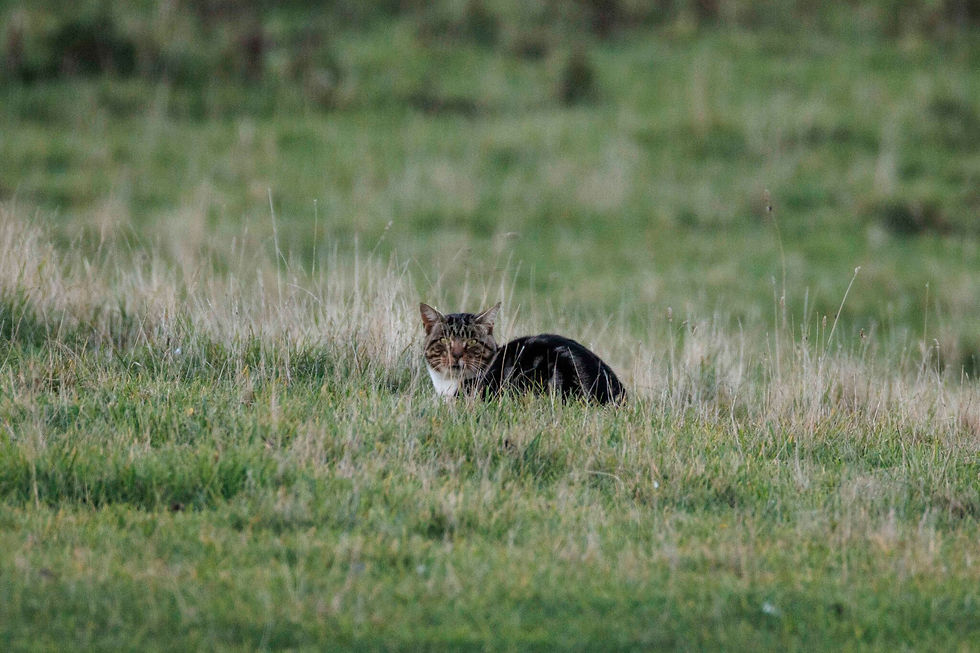
If a forested area is made up of narrow corridors, edges, and tracks, predators like feral cats can move through it efficiently and pose a greater risk to native wildlife. This is especially true for kōkako, which rely on continuous canopy and have limited ability to cross open spaces, particularly during dispersal and breeding seasons.
Reconnecting forests must go hand in hand with managing predators and edge effects, otherwise, corridors can favour predators rather than provide safe habitat.
The Wider Impact Beyond Kōkako

The impact of feral cats extends far beyond kōkako.
They prey on:
ground-nesting and low-nesting birds
fledglings and juveniles of many species
lizards, skinks, and geckos
large invertebrates and bats
Managing feral cats is not about one species - it’s about protecting entire ecosystems and the many taonga species that depend on them.
What Works
Effective feral cat management is:
Targeted - focused on high-value conservation areas and corridors
Evidence-based - guided by monitoring and ecological data
Humane - using best-practice methods
Collaborative - involving iwi, landowners, councils, hunters, and community groups
Responsible pet ownership especially near bush edges and native habitat is also critical, helping reduce the movement of cats into sensitive areas.
Why This Matters for the Corridor
Kōkako recovery depends on more than predator control in forest cores.It requires managing everything that moves through the wider landscape, including predators that operate quietly and invisibly in the spaces between forests.
Protecting kōkako means thinking at a landscape scale.
Ethics, Emotion, and Ecology
The conversation around feral cats is emotionally charged - and understandably so. Cats occupy a unique place in human culture, where affection, responsibility, and wildlife protection collide.
Questions about animal welfare, ethics, and responsibility matter. But from a conservation perspective, the ecological reality remains unchanged: feral cats are highly effective predators in ecosystems that evolved without them.
For programmes like KEEP, the focus is not on cultural symbolism or individual animals, but on outcomes for native wildlife and ecosystems. Protecting kōkako and other taonga species requires managing all significant threats including predators that operate quietly across forest edges and corridors.
Ethical reflection and ecological action are not opposites. But without action, the consequences for native species are permanent.
Glossary: Cats in a Conservation Context
Pet cat: A cat that is owned, fed, and cared for by people. Pet cats usually live close to homes but may roam and hunt wildlife. From a conservation perspective, any pet cat that kills native wildlife is causing harm, even if unintentionally.
Stray cat: A cat that lives around human settlements but is not directly owned or consistently cared for. Stray cats may rely partly on people for food and shelter and can move between urban, rural, and edge environments.
Feral cat: A cat that lives and breeds entirely in the wild, with no reliance on people. Feral cats hunt full-time, range widely, and occupy forests, farmland, and remote landscapes. They pose a major threat to native wildlife at a landscape scale, particularly in conservation areas and ecological corridors.
Why the distinction matters: While any cat that kills native wildlife has a negative impact, feral cats create a much larger and more persistent problem because they live permanently in native habitats and hunt continuously. This resource focuses on feral cats for that reason.
Bring the facts to the table
Join the KEEP mailing list to be the first to hear when new blogs and free Kōkako Expert & Advocate knowledge packs are released - clear, practical resources you can return to long after the Christmas conversations are over.
About this resource
Information compiled by the Kōkako Ecosystem Expansion Programme (KEEP), drawing on expert input from the Kōkako Recovery Group, local conservation practitioners across the Bay of Plenty and published research.
© KEEP 2025 | keep.org.nz


Comments